


About a year ago, I started working on Fuzzamoto, a fuzz testing tool for Bitcoin full nodes. In this series of blog posts, I will share my experiences, insights and open challenges encountered during its development. This first part will cover the motivation behind creating Fuzzamoto and give an overview of its design and architecture. In later parts, I will dive deeper into determinism, testcase generation and mutation, bugs found, fuzzing feedback beyond coverage and lots more.
Motivation
As of today, Bitcoin Core is the most widely deployed implementation of the Bitcoin protocol on the network and as such it carries the burden of bugs potentially having catastrophic impact. As a result, Bitcoin Core has a very conservative development culture, which is necessary and a strength to some extent (certainly a big reason why there aren’t many serious bugs) but also leads to frustration, burn out, and slow progress on important projects.
Even if you just aim to improve the testing, by refactoring existing code to be more testable and adding tests, you will likely face significant resistance. The project’s resources are limited and complex refactoring PRs are simply not as attractive to reviewers as a 20% speedup in initial syncing time, P2P protocol features or trivial changes that require less time and effort to review. To make things worse, if you have to refactor code to add more tests, there is a risk of introducing bugs during the refactor itself. This creates a chicken-and-egg problem, because tests would de-risk the refactoring, but adding tests requires refactoring.
These refactors typically decouple components, carve out code into their own modules, or add interfaces to make mocking possible, which are often necessary to allow for efficient in-process/persistent-mode fuzzing. For example, fuzzing is slow and scales poorly if the component under test depends on disk I/O, so you want to be able to mock it out.
At this stage major improvements to testing in Bitcoin Core (ones that turn up serious existing bugs or prevent them going forward) are still very much possible. For example, P2P code relating to valid blocks, transactions or compact blocks is not fuzzed, same for chain reorganizations and other similar more involved code paths. Being able to test these efficiently with classical in-process harnesses requires changes to critical code (consensus, P2P, …), code that is not under test to the extent that it should be.
I can say from personal experience that trying to get buy-in for these refactors is painful and I have lost interest in maintaining PRs, for months or years, whose benefits are seemingly often outweighed by the higher churn rate of features and trivial changes.
Faced with this situation, it became clear that Bitcoin Core would benefit from tests that avoid adding undue burden to the conservative review process and do not require any changes to Bitcoin Core itself, to accelerate the closing of remaining testing gaps and de-risk future changes. The ultimate vision for this is an external testing suite that gets as close as possible to taking production binaries as input and producing bugs as output.
Bitcoin Core’s functional tests were the closest thing to this idea as they spawn entire full nodes and test them through their external interfaces (RPCs, P2P, IPC, etc.). No refactoring is needed to write functional tests, at most new RPCs have to be added to be able to inspect some state. While these tests achieve great code coverage and find a lot of bugs, they are not property based tests and don’t automatically explore edge cases. For example, a single line patch to the functional tests would have found CVE-2024-35202 but it was actually found through refactoring and writing new fuzz tests (tests and refactoring that, by the way, were never merged into Bitcoin Core). If the functional tests were property based tests, then perhaps they could have found the issue.
After realising this, I asked myself: what if we had “functional fuzz tests”? Same testing concept as the functional tests but instead of hard coded testing scenarios with expected outcomes we use fuzzing to test properties at the system level. This is the idea behind Fuzzamoto: full-system fuzz driven simulations.
Design
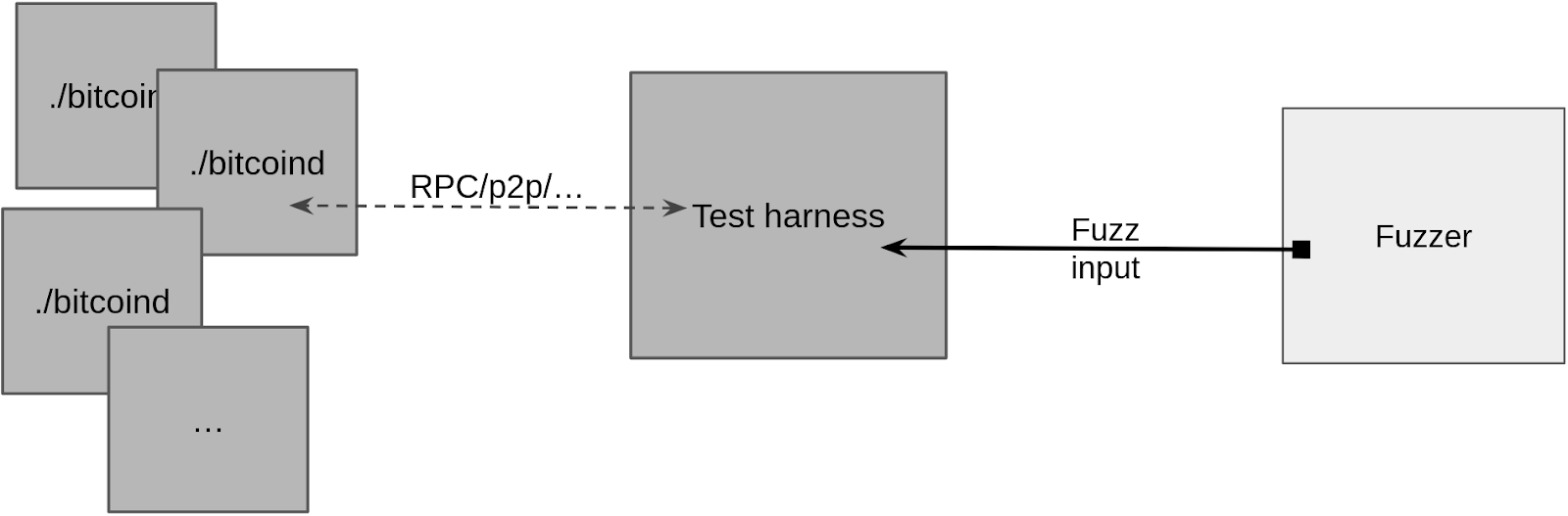
At a high-level, fuzzing with Fuzzamoto involves the target full node daemons (e.g. bitcoind, btcd, …), a testing harness that controls test execution given a fuzz input, and a fuzzing engine that produces inputs for the harness to execute.
Snapshot Fuzzing
One obvious challenge that needs to be addressed is that a naive implementation
of this would result in state accumulation in the target nodes across fuzzing
executions, which would lead to non-determinism. I will get more into
determinism and its challenges in one of the next parts of this blog series, but
the tldr is: for fuzzing to be efficient we want testcase execution to be
deterministic, i.e. given the same input, the behavior of the test should be the
same.
Fuzzamoto uses full-system snapshot fuzzing to address this state challenge.
This works by running the target nodes and testing harness in a special virtual
machine that has the ability to take a snapshot of all its state (memory, CPU
state, devices, …) and quickly reset itself to that state. Currently, Fuzzamoto
uses Nyx as the VM backend but in theory any backend
with similar capabilities would work.
This allows us to avoid repeating expensive state setup and teardown each iteration. We can simply set up the desired state in the beginning, then take the snapshot and fuzz from there, resetting the VM back to the initial state quickly at the end of each execution. For fuzzing Bitcoin full nodes specifically, this allows us for example to premine a chain that provides mature coinbases available for spending in the test right away.
We will get into the technical details on how Nyx works, is used and how coverage guidance works in this model in a future part of this blog series.
Scenarios
The fuzzing harnesses in Fuzzamoto are dubbed “scenarios” and are responsible for snapshot state setup, controlling fuzz input execution and reporting results back to the fuzzer. Each scenario needs to implement two functions:
- Scenario creation and snapshot state setup, i.e. spawning target full node processes and bringing them into the desired state for the fuzzing campaign.
- Testcase execution, i.e. executing a testcase in the context of the previously created state.
Specific scenarios exist for testing the http server, wallet migration, the RPC interface or specific peer-to-peer protocol flows like compact block relay. These all take raw bytes as input and use Arbitrary to parse the bytes into a structured testing input, which then gets executed against the target. Since the input is a generic byte array we can use AFL++ for fuzzing these scenarios, as it provides support for snapshot fuzzing with Nyx.
As I was working on independent scenarios for testing various P2P protocol flows (transaction relay, compact block relay, chain reorganizations, …), it occurred to me that it would actually be beneficial to have overlap between them. For example, for testing compact blocks or chain reorganizations it is not far fetched to assume that also submitting transactions of different shapes and types to the node under test (just like a transaction relay scenario would) could potentially trigger bugs. This line of thought led to developing a very broad scenario for targeting the entire P2P surface of nodes, all at once. Purpose built for fuzzing this scenario, Fuzzamoto includes a custom LibAFL based fuzzing engine, which we will get into in more detail in a later part of this series.
Early Success: RPC Block Index Bug
One of the first scenarios I wrote, targeted the RPCs of Bitcoin Core and in
particular aimed at combining (un)related sequences of RPCs in interesting ways.
The scenario calls RPCs in fuzzer chosen order and will either parse parts of
the fuzz input into RPC inputs or choose from a pool of previously returned
values by other RPCs. For example, if the test calls generatetoaddress it
might later on pass the returned block hashes to other RPCs as input or consume
a hash from the fuzz input.
This scenario was able to find a bug in the block index data structure which
only manifests through use of the invalidateblock and reconsiderblock RPCs
(only used for testing).
bitcoind: validation.cpp:5392: void ChainstateManager::CheckBlockIndex(): Assertion '(pindex->nStatus & BLOCK_FAILED_MASK) == 0' failed.
While this bug is not particularly interesting from a security perspective (triggered through test-only RPCs), it highlights the strengths of the full-system approach: it was immediately clear that this is a bug and not a false positive (i.e the daemon crashed, which should never happen) and the use of snapshot fuzzing enabled efficient state resets that would otherwise only be possible with refactoring.
The same bug was also found by other contributors who refactored and wrote a fuzz test for the block index code. The PR to add this work to the repository was open for a whole year before it was merged!
Since Fuzzamoto tests run at the same level as the functional tests, we can convert any Fuzzamoto testcase into a Bitcoin Core functional test (this will work as long as the bug is deterministically reproducible). For example, the following functional test reproduces the block index bug:
from test_framework.test_framework import BitcoinTestFramework

class CheckBlockIndexBug(BitcoinTestFramework):
    def set_test_params(self):
        self.setup_clean_chain = True
        self.num_nodes = 1

    def run_test(self):
        self.generatetoaddress(self.nodes[0], 1, "2N9hLwkSqr1cPQAPxbrGVUjxyjD11G2e1he");
        hashes = self.generatetoaddress(self.nodes[0], 1, "2N9hLwkSqr1cPQAPxbrGVUjxyjD11G2e1he");
        self.generatetoaddress(self.nodes[0], 1, "2N2CmnxjBbPTHrawgG2FkTuBLcJtEzA86sF");

        res = self.nodes[0].gettxoutsetinfo()
        self.generatetoaddress(self.nodes[0], 3, "2N9hLwkSqr1cPQAPxbrGVUjxyjD11G2e1he");
        self.log.info(self.nodes[0].invalidateblock(res["bestblock"]))
        self.generatetoaddress(self.nodes[0], 3, "2N9hLwkSqr1cPQAPxbrGVUjxyjD11G2e1he");
        self.nodes[0].reconsiderblock(hashes[0])
        self.nodes[0].invalidateblock(hashes[0])
        self.log.info(self.nodes[0].reconsiderblock(res["bestblock"]))

if __name__ == '__main__':
    CheckBlockIndexBug(__file__).main()
This way the developers triaging the bug, do not have to deal with setting up Fuzzamoto and can debug the issue using the tools they are familiar with.
For a complete list of issues found and published so far, have a look at the trophy section in the project’s readme.
The next post in this Fuzzamoto series will cover considerations around non-determinism.
About Brink
Brink is a Bitcoin research and development centre, founded in 2020 to support independent open source protocol developers and mentor new contributors. If you or your organization is interested in supporting open source Bitcoin development, feel free to email us, donate@brink.dev.
Developers interested in the grant program can apply now.
Keep in touch
Subscribe to the Brink newsletter for future blog posts.