


In the second part of the Fuzzamoto blog series, I highlighted the struggle of non-determinism in testing/fuzzing, sources of non-determinism, and some crafty workarounds for reducing non-determinism in Fuzzamoto.
In this blog post, I’ll go over a general solution to achieving full determinism in software testing: building a deterministic hypervisor. In particular, I’ll dig into the challenge of emulating time, and how to trigger virtual machines to exit at precise instruction counts, by (ab)using the CPU’s performance monitoring unit.
I am not the first person to attempt building something like this, Antithesis has built a deterministic hypervisor and an entire autonomous testing platform around it. As far as my own experience goes, they have built one of the most advanced and usable fuzzing/property-based testing systems that exists today. Their entire system is proprietary and closed source, so when I read their blog post “So you think you want to write a deterministic hypervisor?,” I immediately thought, “Yes, I think I do.”
There was just one problem, I had no idea what a hypervisor even is or how they work, besides an abstract notion of “a thing that manages virtual machines.” So to get started, I opened up claude code and started prompting. Unfortunately, it is not quite as easy as “Claude, build me a deterministic hypervisor, make no mistakes”, but 8+ months later, Claude and I have managed to produce something that seems to work: bedrock.
So what actually is a hypervisor? A hypervisor is the software that runs a virtual machine: it uses hardware virtualization support (e.g. Intel® VT-x) to execute the guest’s code directly on the physical CPU at native speed, while retaining the ability to intercept anything the guest does. The mechanism is the VM exit, the CPU runs guest instructions until the guest touches something the hypervisor has asked to intercept, at which point control flows back to the hypervisor, which handles the event and resumes the guest. In simplified terms, you can think of it as one big loop, which runs a VM, and upon exit consults a giant switch statement for how to handle the particular exit, after which the next loop iteration starts and the VM is resumed.
Claude started out by telling me that we can just use stock KVM (the hypervisor
that ships with the linux kernel), configure it to exit whenever the guest
attempts to do something non-deterministic (e.g. execute the rdtsc instruction),
and emulate the action instead. This idea is conceptually correct, but as we
will see, it is not tenable. The insight behind why a deterministic hypervisor
is a generic solution to software determinism, is that all non-determinism comes
from the underlying hardware, and the hypervisor can act as a determinism
boundary between the software we want to test and the hardware beneath it.
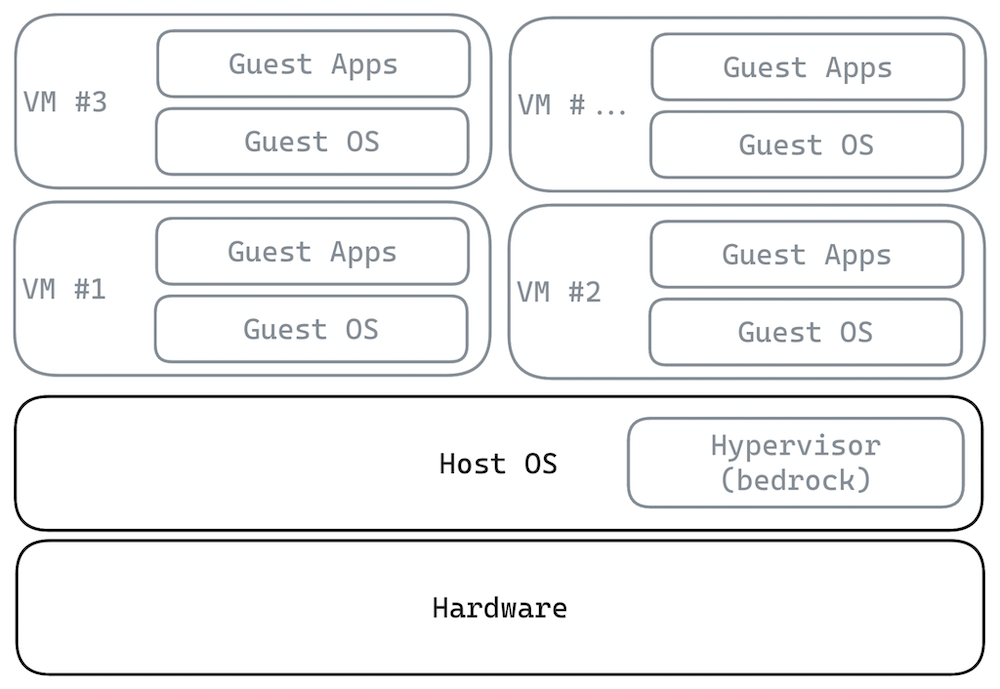
Anyone who knows what they are doing (not me), would immediately have known that stock KVM will not be able to do this, as it does not have the required configurability, and wasn’t at all designed with this use case in mind. You could take the KVM source code and modify it to support deterministic execution (this is what Antithesis did, not with KVM but with bhyve), but not use it out of the box.
Today, I realise that choosing an existing hypervisor and modifying it to become deterministic would have been the smarter route (I probably spent a month or more just getting a linux kernel to boot), but - and I can’t remember why - I chose to build mine from scratch. The first 2-3 iterations of this were written in C as a linux kernel module, but eventually - after many host kernel panics caused by memory unsafety issues, a lack of tests, and forgetting to re-enable kernel preemption in some exit paths - I chose to rewrite my kernel module in Rust. You can of course write tests for kernel modules written in C, but with Rust I was able to use traits to create abstractions over kernel or hardware features, and write standard cargo unit tests for hypervisor logic that run in userspace.
The userspace tests turned out to be less useful than I originally thought, as most of the really annoying bugs actually came from misusing hardware features or the kernel API (exactly the thing the unit tests weren’t exercising). To address this, I created Claude skills that gave the LLM access to the 5000 pages of the Intel® Software Developer Manual (SDM), as well as the source code of the exact linux kernel version the module was depending on. These skills were a major improvement to the LLMs capability in producing correct code the first time, debugging bugs that popped up, and exploring required hardware features. The SDM skill was also especially great for my own understanding, as it improved the accuracy of Claude’s explanations a lot.
Since bedrock is not aiming to be general purpose hypervisor, a lot of simplifications can be made, including but not limited to: only supporting a specific set of modern Intel® x86 CPUs with Intel® VT-x, VMs managed by the hypervisor only ever having one CPU, only supporting a specific set of Linux kernel versions for the guest and host, and not making security a concern.
Emulating Time
I would like to now deep dive into one of the obvious things that a
deterministic hypervisor will have to do: emulate time. The guest can not be
allowed to observe the actual hardware timestamp counter (TSC), or its execution
would depend on the non-deterministic nature of the real TSC. The hypervisor’s
job is to force the VM to exit whenever it tries to read the real TSC, and return
an emulated value instead. This requires trapping instructions such as rdtsc and
certain model-specific register (MSR) reads, as well as finding some
deterministic metric that can act as a proxy for the time the guest spent
executing.
Claude’s first naive suggestion was to count the number of VM exits, and report this exit count as the emulated tsc back to the guest. VM exit count is obviously not a great proxy for time, as the time passed between exits can wildly differ. What most deterministic hypervisors do is count the number of instructions executed by the guest, and use the recorded instruction count divided by the hosts clock frequency as the emulated tsc. This is not perfect either, as not all instructions take the same amount of time to execute, but works well enough.
The emulated tsc is also used to decide when to inject timer interrupts. This is where things get tricky, because halting the guest at a specific emulated tsc value (i.e. at a specific instruction count N) to inject an interrupt at the right time is not a documented use case for Intel® CPUs. A naive “solution” here is to just not do precise interrupt delivery, and only inject interrupts at the natural deterministic exit boundaries. I measured how inaccurate this approach is, and the worst observed timer injection delay was ~0.2 seconds in virtual time.
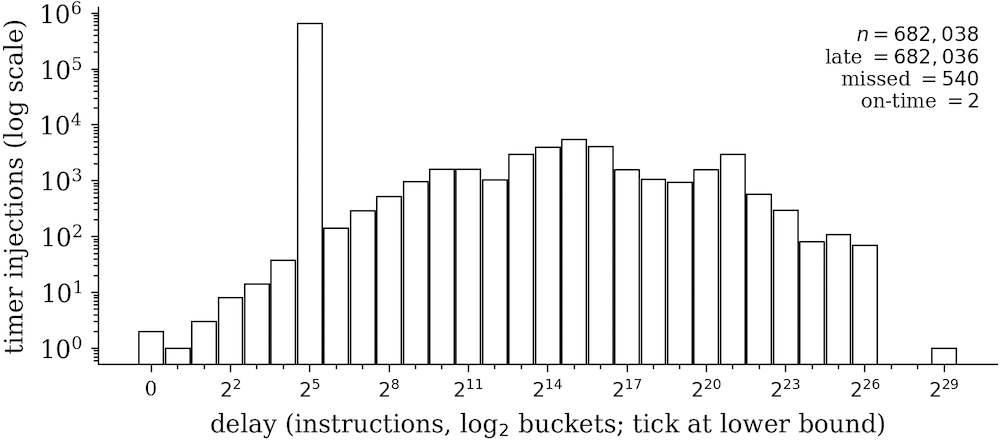
Even though this seemed to work - and I didn’t observe any unexpected behavior from the guest due to the imprecision - the timer interrupts are what drives the linux kernel task scheduler, and probably assumed to work reliably by most software. In addition to this, we’ll also need to use precise interrupt delivery to inject other events (e.g. executing bash commands) into the guest. In the context of testing, this imprecision could also lead to missed bugs. So we need some mechanism for triggering VM exits at precise instruction counts.
The performance monitoring unit (PMU) supports various performance monitoring counters (PMCs) that are normally used (as the name suggests) for software benchmarking purposes. There are PMCs that can be programmed to countdown instructions, and trigger a performance monitoring interrupt (PMI) when the counter reaches zero. This is achieved by setting the counter to its maximum value minus the desired instruction count N, as the counter will count up by one for each executed instruction, and trigger the PMI sometime after it overflows.
While we can intercept PMIs with the hypervisor, these interrupts are delivered asynchronously through the advanced programmable interrupt controller (APIC) while the guest continues executing. Antithesis also mentions this in their blog post “PMC supports a threshold notification system, where you set up the counter as a “countdown” and get an interrupt when the value reaches zero. However, since this interrupt is delivered through the APIC, dozens of instructions will be processed before the CPU is actually notified of the threshold event. Moreover, this interrupt delivery overhead is quite varied when measured in CPU cycles, meaning that you really don’t know how long ago an interrupt was triggered from the time you receive it”. I measured this PMI delay, as can be seen in the plot below.
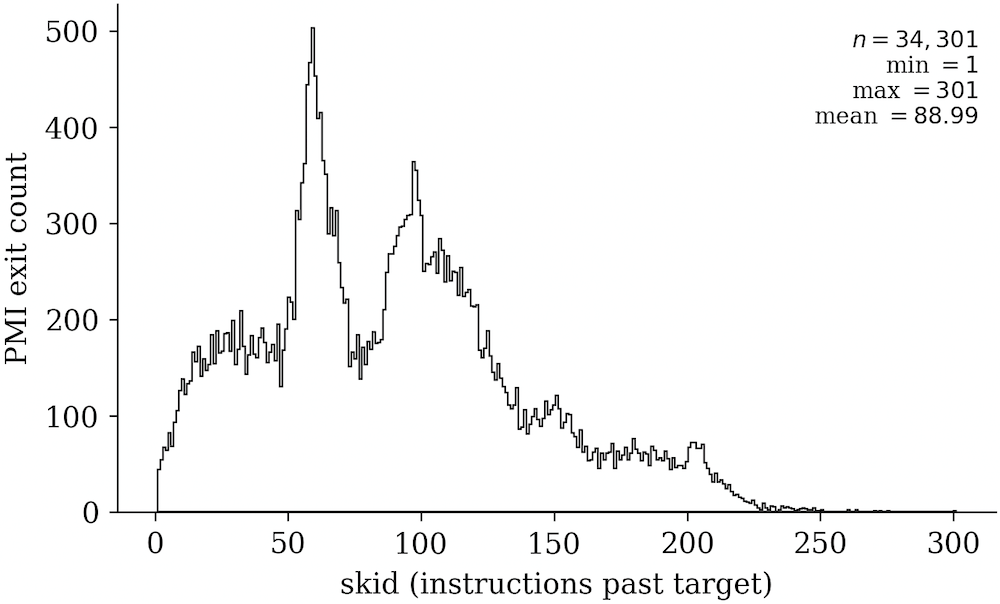
In this dataset, with rather few samples (~34k PMI exits), I observed a maximum skid (instructions executed past the target) of 301 instructions. From my experiments, this is actually sufficient to create a precise exiting primitive by applying a skid margin to the exact instruction count we are interested in, and absorbing the skid with monitor trap flag (MTF) based single stepping.

That is, we program the INST_RETIRED.ANY PMC to overflow at instruction N minus our skid margin M, and then we single step the rest of the margin window up to N. In my testing this did seem to work, and looked to be deterministic, but, especially under nested virtualisation (which can be useful for testing), the performance overhead of this much single stepping really wasn’t satisfactory. The Antithesis blog post and the SDM also contain hints that made me think I can do better.
In particular, the precise event based sampling (PEBS) feature caught Claude’s and my attention, as it promises precise instruction counting, especially in its precise distribution mode (PDist). In my testing, using PEBS reduced the observed skid from hundreds of instructions to dozens. My understanding is that the INST_RETIRED.ANY PMC method above actually has two different delays baked into the observed skid distribution, the APIC delay as well as a prior delay between the counter overflowing and the actual PMI being triggered. But with PEBS in combination with PDist, we only suffer the PMI delay, so the observed skid distribution contracted, as seen in the following plot.
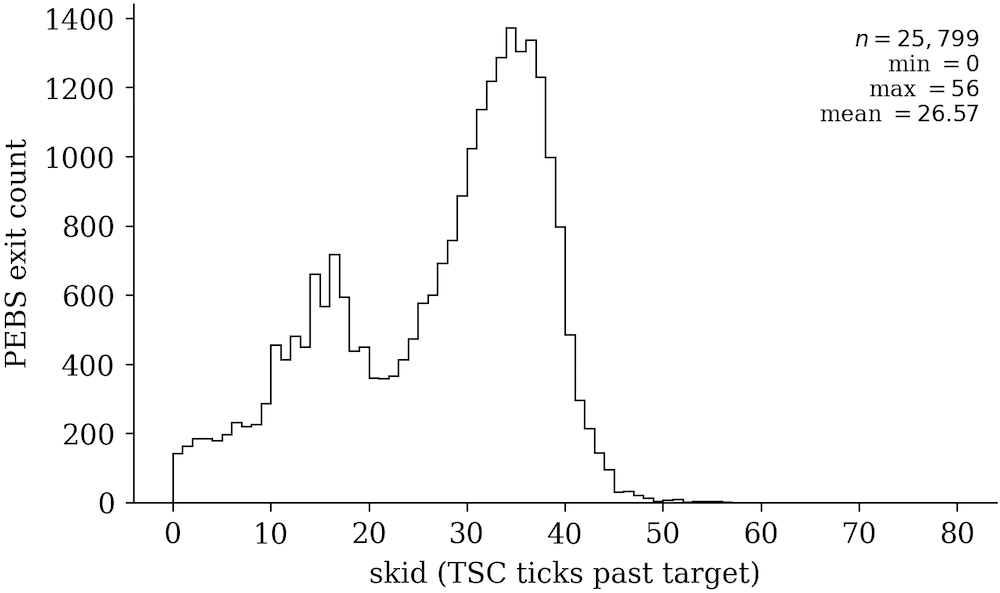
This was getting closer to the optimal target of zero skid, and while this already kind of seemed good enough, I was curious if this could be pushed even further.
When a PEBS+PDist counter overflows the CPU writes a PEBS record to a memory location you set up beforehand, precisely after the instruction that triggered the overflow. The record contains some CPU register values right after the time of the counter overflow, and can be programmed to contain other data as well. However we are not interested in the record contents, but rather just the fact that something is being written to memory very close to the precise time we care about. Can we set up the PEBS buffer location in a way that triggers a VM exit? Perhaps an extended page table (EPT) violation? EPT violations are VM exits - not interrupts - and therefore do not get delivered through the APIC, so if this is possible, we would avoid the APIC PMI delay. Turns out, on CPUs with the Ice Lake-SP (or newer) microarchitecture, this is a supported feature called EPT-friendly PEBS, which lets us set the PEBS buffer location to a guest-linear address and more importantly reliably trigger an EPT violation on the PEBS buffer write. Using this we get the following skid distribution on a Sapphire Rapids CPU.
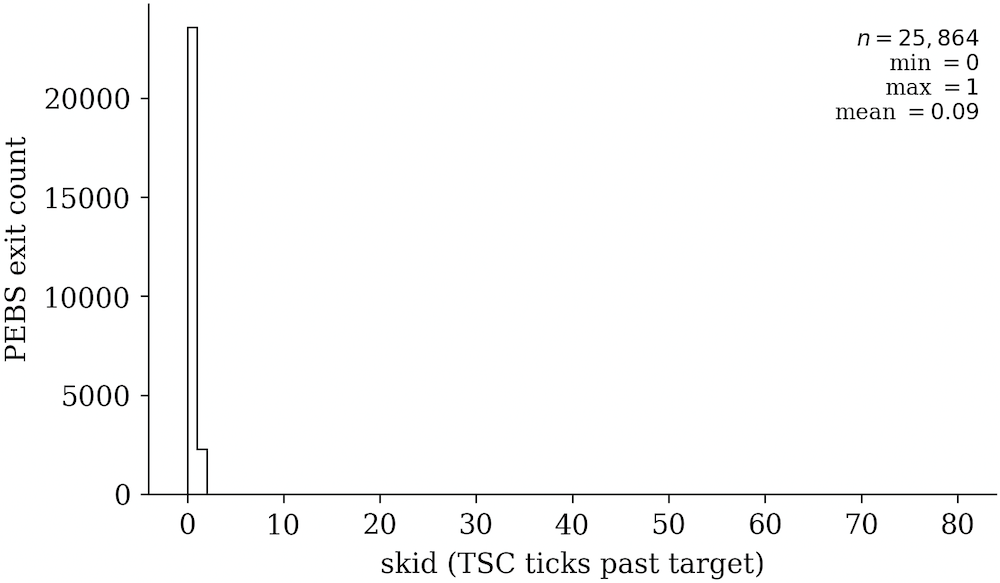
Boom, (mostly) zero skid!1 But where does the 9% of observed one instruction skid come from? From what Claude told me, using PEBS+PDist requires a minimum counter reload value of 256 instructions, meaning if two precise exits are closer than 256 instructions apart, we can’t use PDist and the default PEBS behavior of writing the record at N+1 instruction applies. Given this sometimes +1 skid behavior (which also happens non-deterministically in the case of e.g. external interrupts), we still have to rely on MTF single stepping, but at least only a few instructions, as opposed to dozens or hundreds!
Is this the mechanism that Antithesis alludes to in their blog post? I don’t think so, or at least not directly as they use machines running the Skylake microarchitecture for their product, which should not support EPT-friendly PEBS. However, it could be possible that they found a way to get the same behavior through some undocumented feature. They note: “We were pushing various features of the CPU just a bit past what they were really designed for, which meant carefully probing their real, undocumented functionality every step of the way”. Maybe they found some completely different mechanism, or just accept a higher single stepping overhead (I doubt it), but it is up to them to reveal their secrets.
Conclusion
Up until about a year ago, when someone mentioned Antithesis to me at a local meetup, I thought that full determinism in software testing was an elusive goal. Learning about their product and building bedrock has completely changed that perspective. What started as an intimidating, abstract concept became a tangible project through hours of iterative prompting and deep-dives into the Intel® SDM alongside Claude. This project has been a welcome reminder that even the most complex systems can be demystified with the right tools and enough persistence.
This post focused on emulating the clock and in particular how to achieve precise VM exits. The hypervisor already supports many other cool features (copy-on-write VM forking, a deterministic I/O channel between guest and hypervisor, …), and I might write more posts about this in the future. If you are curious about some specific aspect please let us know.
There is also still a ton to be implemented and tinkered with. If this post piqued your interest, feel free to ping me about contributing, or just checkout the repo and go from there.
About Brink
Brink is a Bitcoin research and development centre, founded in 2020 to support independent open source protocol developers and mentor new contributors. If you or your organization is interested in supporting open source Bitcoin development, feel free to email us, donate@brink.dev.
Developers interested in the grant program can apply now.
-
On an Ice Lake-SP CPU the observed skid distribution was a few instructions larger. My hypothesis is that this is due to the used PMC only having cycle granularity on Ice Lake-SP, as opposed to instruction granularity on Sapphire Rapids. ↩
Keep in touch
Subscribe to the Brink newsletter for future blog posts.